

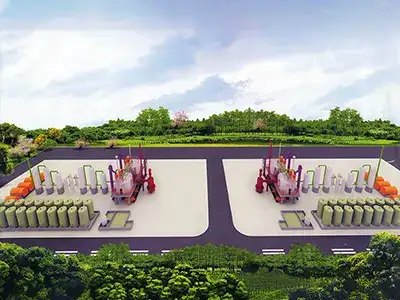


Potassium Sulfate (SOP) Fertilizer Production Line (20,000-80,000 t/y)
Complete SOP fertilizer production system supporting the Mannheim process and the double-decomposition process
Potassium sulfate is produced through secondary conversion processes using potassium chloride as the primary feedstock.
Industrial SOP production methods include: Mannheim process, double-decomposition process, Glauber’s salt conversion process, ammonium sulfate double-decomposition process.
Among these, the Mannheim process and the ammonium sulfate double-decomposition process are the most mature and widely applied industrial routes.
- Mannheim Process
- Double-Decomposition Process
- Typical capacity: 20,000 t/y, 40,000 t/y, 80,000 t/y
- Product quality: Main product: complies with GB/T 20406-2017 Potassium Sulfate for Agricultural Use
- By-product: complies with HG/T 3783-2021 - By-product Hydrochloric Acid
Potassium chloride with a particle size of less than 2mm is fed into the Mannheim furnace together with concentrated sulfuric acid (98 wt%) at a controlled ratio. In the first reaction stage, potassium bisulfate is formed with the release of heat. At an operating temperature of 500-540°C, potassium bisulfate further reacts with potassium chloride to form potassium sulfate.
At the bottom of the furnace, plowshares push the potassium sulfate toward the discharge outlet. The product is cooled to approximately 60°C in a graphite cooler and then conveyed for screening and crushing.
The undersize potassium sulfate is neutralized to remove residual acidity, followed by weighing and packaging as finished product.
The furnace off-gas, mainly containing hydrogen chloride (HCl) and impurities, is cooled in a graphite cooler and then routed to a cooling scrubber and a packed scrubbing tower, where concentrated hydrochloric acid is used to remove potassium chloride and sulfuric acid.
The gas stream subsequently enters a falling film absorber, where diluted hydrochloric acid is used as the absorbing liquid. After two-stage absorption, concentrated hydrochloric acid is obtained at the bottom of the second falling film absorber.
Residual hydrogen chloride and impurities not absorbed by sulfuric acid are stripped in a desorption tower and further treated in an HCl recovery tower and tail-gas scrubbing tower, where hydrogen chloride is absorbed by water. The treated exhaust gas is finally discharged by an induced draft fan.
- Potassium chloride elevated silo
- Sulfuric acid storage tank
- Sulfuric acid elevated tank
- Combustion furnace
- Mannheim reaction furnace
- Cooler
- Neutralization tank
- Screening machine
- Packaging machine
- Crusher
- Graphite cooler
- Screw conveyor
- Limestone feeder
- Buffer tank
- Hydrochloric acid buffer tank
- Intermediate hydrochloric acid tank
- Hydrochloric acid pump
- Circulating water pump
- Furnace gas exhaust fan
- Induced draft fan
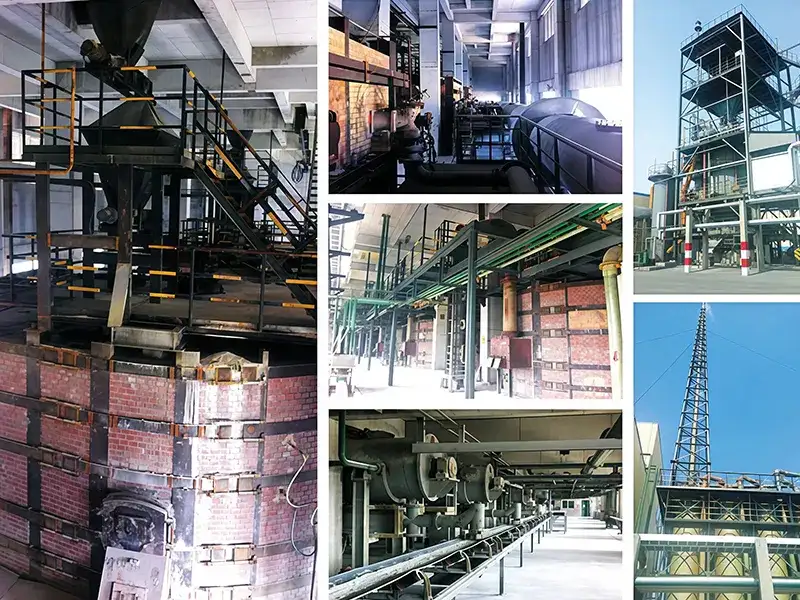
- Typical plant capacity: 20,000 t/y, 50,000 t/y, 100,000 t/y
-
Product quality:
-
Main product: Complies with GB/T 20406-2017 Potassium Sulfate for Agricultural Use
By-product: Potassium ammonium chloride with N≥21±1 wt%, K₂O = 6±1 wt%
In the double-decomposition process, potassium sulfate is produced from potassium chloride and ammonium sulfate through a two-stage conversion process. The potassium-rich stock solution obtained from the two stages is proportioned with ammonium sulfate to form a slurry, which reacts in the first-stage converter.
The resulting supernatant is cooled to obtain the by-product potassium ammonium chloride and an ammonium-rich stock solution.
The ammonium-rich stock solution is heated to the required process temperature and fed, together with potassium chloride and potassium washing liquid, into the second-stage converter at a controlled ratio.
After reaction, the supernatant phase forms potassium-rich stock solution, while the solid phase is crude potassium sulfate. The crude potassium sulfate is washed with water to separate the final potassium sulfate product and washing effluent (containing potassium), which is recycled within the system.
Main Equipment- Bucket elevator
- Belt weighing feeder
- Settling centrifuge
- Two-stage pusher centrifuge
- Vacuum crystallizer
- Three-stage steam ejector
- Preheater / heater
- Mixing condenser
- Forced circulation pump
- Conversion crystallizer
- Water-ring vacuum pump
- Hydrocyclone overflow tank
- Process pumps
- Cooling tower
- Cooling water basin
- Centrifugal washing tank
- Water-ring pump buffer tank
- Storage tanks
- Belt conveyor
- Packaging machine
Delandi (Nantong) Machinery is dedicated to the development of the fertilizer industry, focusing on process design, production equipment manufacturing, and production performance improvement for fertilizer manufacturing projects. We bring together a team of experienced professionals with deep technical knowledge and long-term industry involvement.