

Thermal-Process Phosphoric Acid Production Line (30,000-100,000 t/y)
Complete phosphoric acid production system for manufacturing food-grade phosphoric acid
Thermal-process phosphoric acid is produced using the electric furnace two-step route. Phosphate rock is first reduced in an electric furnace to produce elemental phosphorus (white phosphorus). After dust removal and cooling, phosphorus vapor is condensed into liquid phosphorus. The liquid phosphorus is then combusted, hydrated, and demisted to produce phosphoric acid.
- White Phosphorus Process
- Acid-Cooling Process
- Water-Cooling Process
Phosphate rock, silica, and coke are crushed, dried, and screened, then proportioned and fed into a sealed electric phosphorus furnace. Using carbon as the reducing agent, the furnace is electrically heated to approximately 1500℃, producing phosphorus-containing furnace gas. After dust removal and cooling, elemental phosphorus is condensed into liquid white phosphorus.
- Typical capacity: 2x10,000 t/y, 2x12,500 t/y, 2x15,000 t/y
- Product quality: Complies with GB/T 7816-2018 Industrial White Phosphorus
- Phosphorite (P₂O₅=30%): 8.48t
- Silica (SiO₂=95%): 3.73t
- Coke (FC≥80%): 1.59t
- Graphite electrode (Ø700): 0.023t
- Power consumption: 13,000-15,000kWh
- Fresh water: 5t
- Comprehensive energy consumption: 2,280kgce/t
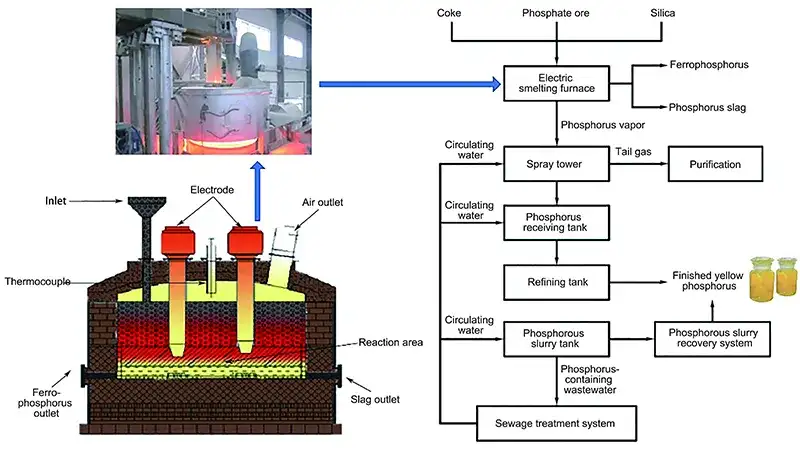
Smelting electric furnace, including: furnace body, furnace charge feeding system, graphite electrodes, thermocouples, furnace gas outlet system
- Suitable for medium- and low-grade phosphorite.
- Application of patented fine-ore pelletizing and sintering technology.
- Utilization of wet-process phosphoric acid sludge and tailings blended with phosphate rock; pellets produced by powder granulation or compaction granulation meet electric furnace feed requirements
(pellet size: 20-50mm; compressive strength≥170N; phosphorus reduction rate≥95%; processing cost approximately CNY 80/t; energy consumption reduced by about 0.2tce per ton of white phosphorus) - Patented self-baking electrodes instead of graphite electrodes, significantly improving furnace stability, reducing operating intensity, and lowering power consumption by approximately 2,000kWh per ton of white phosphorus
- Advanced phosphorus distillation technology for recovering white phosphorus from phosphorus sludge, as well as acidulation of sludge phosphorus to produce phosphoric acid and phosphate fertilizers
- Application of three-phase, six-electrode furnace technology
- Increased electrode conductive cross-section, reduced current density, lower electrode consumption, and reduced furnace power consumption
- Automatic electrode control system integrating electro-hydraulic control with fuzzy control modules, enabling automatic electrode lifting balance
- Improved slag cooling process: replacement of water quenching with air quenching, utilizing slag heat for material drying and phosphorus sludge distillation, eliminating wet slag drying and wastewater generation
-
Comprehensive utilization of phosphorus slag, including:
- Raw material for cement, cementitious materials, plastic fillers, ceramsite, non-fired bricks, and concrete
- Production of active calcium silicate fertilizer
- Manufacturing of inorganic refractory insulation fibers
-
Integrated utilization of ferrophosphorus, including:
- Electrode material preparation
- Production of disodium phosphate, trisodium phosphate, and other phosphate products
- Production of nano-scale ferrophosphorus powder for advanced anti-corrosion materials
Thermal process can be classified into the following routes: One-step combustion-hydration process (acid-cooling process), two-step combustion-hydration process (water-cooling process)
- Plant capacity: 30,000-100,000 t/y
- Product quality: Complies with GB 1886.15-2015 National Food Safety Standard, Food Additives: Phosphoric Acid; Complies with GB/T 28602-2012 Technical Specification for Thermal-Process Phosphoric Acid Production
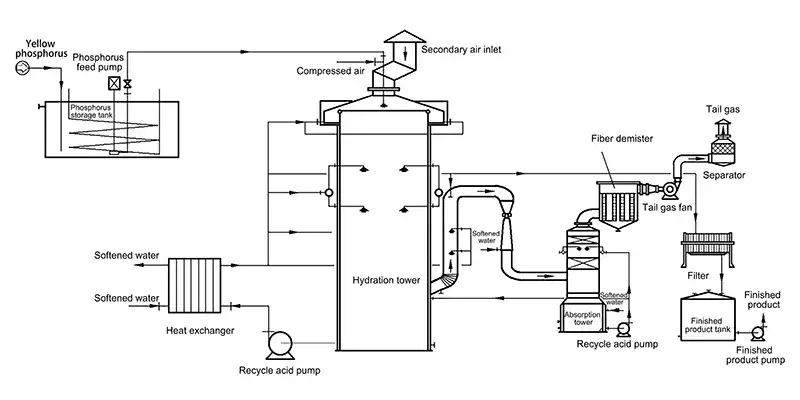
In the one-step combustion-hydration process, white phosphorus is melted in a phosphorus melting tank and fed in liquid form through a nozzle into a combustion-hydration tower. Compressed air is used to atomize the phosphorus for oxidative combustion.
To ensure complete oxidation of phosphorus, secondary air is introduced at the top of the tower at 1.4-2.0 times the theoretical air requirement.
Phosphorus combustion and hydration of phosphorus pentoxide occur within the same equipment. The heat released during phosphorus combustion is removed by spraying a large quantity of pre-cooled dilute phosphoric acid onto the inner wall of the tower.
Most of the cooled phosphoric acid is recycled back to the combustion-hydration tower as circulating acid, while a smaller portion is withdrawn as product. The off-gas passes through an electrostatic mist eliminator, where phosphoric acid mist is recovered before the cleaned gas is discharged to the atmosphere.
- Phosphorus combustion and P₂O₅ hydration are carried out in a single unit
- Short process flow
- Relatively simple equipment configuration
- The combustion-hydration tower must be fabricated from special stainless steel
- Large heat-transfer area required for acid coolers
- Secondary air must be supplied at the top of the tower
- White phosphorus: 270-280kg
- Water: 100m³
- Air: 1,850m³
- Electricity: 160kWh
- Steam: 280kg
- Phosphorus recovery rate: ≥99%
- Phosphorus storage tank
- Phosphorus feed pump
- Combustion-hydration tower
- Heat exchanger
- Dilute phosphoric acid circulation pump
- Absorption tower
- Fiber mist eliminator
- Gas-liquid separator
- Off-gas fan
- Filter
- Product acid tank
- Product acid pump
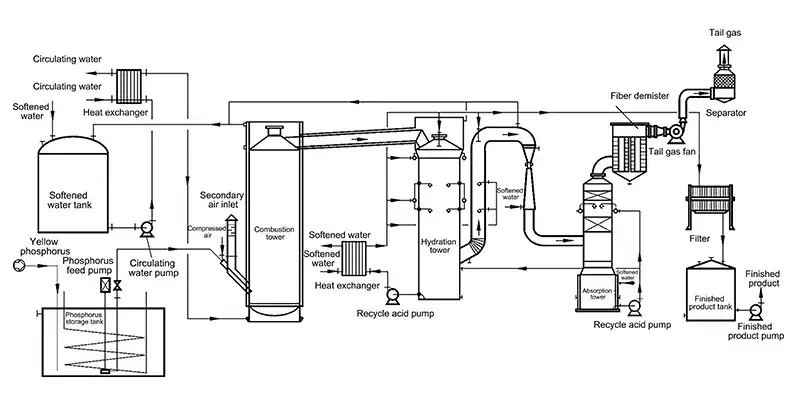
In the two-step combustion-hydration process, white phosphorus is melted in a phosphorus melting tank and fed in liquid form through a phosphorus nozzle into a combustion tower. Compressed air is used to atomize the phosphorus for oxidative combustion.
To ensure complete oxidation, secondary air is introduced at the top of the tower at 1.4-2.0 times the theoretical air requirement. Phosphorus combustion and hydration of phosphorus pentoxide take place in separate units, namely the combustion tower and the hydration tower.
The gas temperature in the combustion zone is approximately 800°C. The outer wall of the combustion chamber is water-cooled, maintaining a wall temperature of 80-125°C.
The gas leaving the combustion chamber enters a graphite gas cooler, where spray water is introduced from the top for cooling. After the gas is cooled to approximately 180°C, it enters the hydration tower, where three-stage water cooling is applied and phosphorus pentoxide is hydrated to form phosphoric acid.
The off-gas then passes through an electrostatic mist eliminator, where phosphoric acid mist is recovered, and is subsequently discharged.
Process Advantages- Combustion of liquid white phosphorus is carried out independently in the combustion chamber, and the heat released during combustion is removed by water cooling.
- After cooling, P₂O₅ in the gas reacts with water to form phosphoric acid.
- Construction materials are mainly graphite plates (tubes) and carbon bricks, providing excellent corrosion resistance.
- The gas cooler requires a relatively small heat-transfer area.
- The design complexity of the phosphorus combustion tower and hydration tower is reduced.
- White phosphorus: 273kg
- Water: 80m³
- Air: 1715m³
- Electricity: 160kWh
- Steam: 280kg
- Phosphorus recovery rate: ≥98%
- Phosphorus storage tank
- Phosphorus feed pump
- Soft water tank
- Circulating water pump
- Combustion tower
- Hydration tower
- Heat exchanger
- Dilute phosphoric acid circulation pump
- Absorption tower
- Fiber mist eliminator
- Gas-liquid separator
- Off-gas fan
- Filter
- Product acid tank
- Product acid pump
| Process | Characteristics | Basis: production of 1t of phosphoric acid with a mass fraction of 85 wt% H₃PO₄ | Phosphorus recovery rate/% | |||
| M (White phosphorus) /kg |
V (Air) /m³ |
V (Water) /m³ |
W (Power) /(kW·h) |
|||
| One-step combustion-hydration process | (1) Combustion and hydration take place in the same equipment; (2) Combustion heat of phosphorus is removed by circulating cooled acid; (3) A relatively large amount of stainless steel is required for equipment construction; (4) Large heat-transfer area is required for acid coolers (for plants of the same capacity, the heat-transfer area is 3-5 times larger than that of the water-cooling process). |
270-280 | 1850 | 100 | 160 | ≥99 |
| Two-step combustion-hydration process | (1) Combustion of liquid white phosphorus is carried out independently in the combustion chamber; (2) Heat generated during combustion is removed by water cooling; (3) After cooling, P₂O₅ in the gas is hydrated to phosphoric acid in the hydration tower; (4) Equipment materials mainly include graphite plates (tubes) and carbon steel; (5) The gas cooler requires a relatively small heat-transfer area. |
273 | 1715 | 80 | 98 | |
In the one-step combustion-hydration process, the heat generated during combustion is removed by circulating acid (with approximately 20% of the heat carried away by the discharged off-gas).
During production, the combustion of 1 t of white phosphorus requires approximately 400-500t of circulating acid. The operational stability of this process relies heavily on the reliability of the acid pumps, coolers, and piping system.
In the two-step combustion-hydration process, the heat generated during combustion is mainly removed through water evaporation, with part of the heat carried away by the discharged off-gas.
This process does not require large-scale acid cooling facilities; however, it places strict requirements on equipment structure and construction materials. With improvements in materials for acid cooling equipment and advances in manufacturing technologies, heat-resistant steels with good performance and spray-coating technologies can be applied to effectively address high-temperature phosphorus flame corrosion.
In addition, cooling of high-temperature off-gas is beneficial for waste heat recovery and energy utilization.
Overall, the two-step thermal-process phosphoric acid route offers better application prospects.
Delandi (Nantong) Machinery is dedicated to the development of the fertilizer industry, focusing on process design, production equipment manufacturing, and production performance improvement for fertilizer manufacturing projects. We bring together a team of experienced professionals with deep technical knowledge and long-term industry involvement.